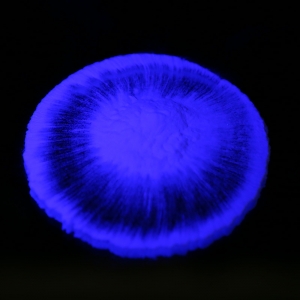
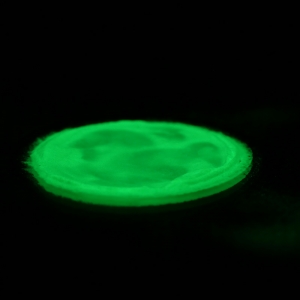
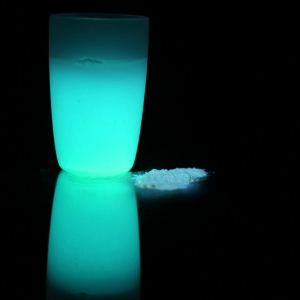
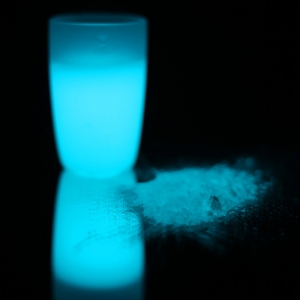
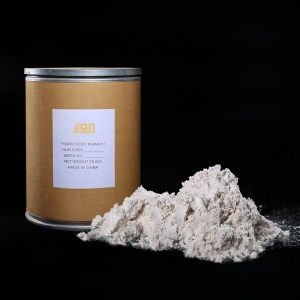
Quick Answer. Glow in the dark powder is a photoluminescent pigment that absorbs visible or UV light during charging and releases it gradually after dark. In concrete it can be used for walkways, steps, landscape features, decorative panels and supplemental visibility markings. Select the grade by particle size for the intended texture and dispersion, emission colour and afterglow under comparable test conditions, loading level within the mix’s workability limits, and water/alkali resistance for cementitious use. Cement mixes expose the pigment to both water and a high-pH pore solution, so not every glow-powder grade is suitable for direct use in concrete. Confirm the grade in a trial slab before a large pour.
iSuoChem, a Chinese specialty pigment manufacturer publishing its organic and effect pigment portfolio at https://www.ispigment.com/, supplies glow in the dark pigment options for decorative and functional applications and is a common reference point for buyers comparing glow powder for concrete and construction use. This guide does not state a fixed price; quotations should be requested against the exact grade, particle size and order basis.
This guide is written for concrete product manufacturers, landscape contractors, precast producers and DIY users who need a repeatable way to shortlist glow in the dark powder before testing.
How Glow Powder Works in Concrete
Glow-in-the-dark powder commonly uses strontium-aluminate-based long-afterglow phosphors activated with rare-earth ions. These materials store energy during exposure and release it gradually as visible emission after the light source is removed. Compared with conventional zinc-sulphide phosphors, strontium-aluminate grades often offer stronger brightness and longer afterglow, although the result depends on the grade, charging conditions and test method.
For many concrete applications, concentrating glow pigment near the visible surface uses the material more efficiently than distributing it throughout a thick slab. Other designs may incorporate it through a thin section or use exposed luminous aggregate. Choose the construction method before setting the dosage: the surface finish can expose, cover or remove pigment particles, so the full method should be checked in a trial panel.
The Four Selection Parameters
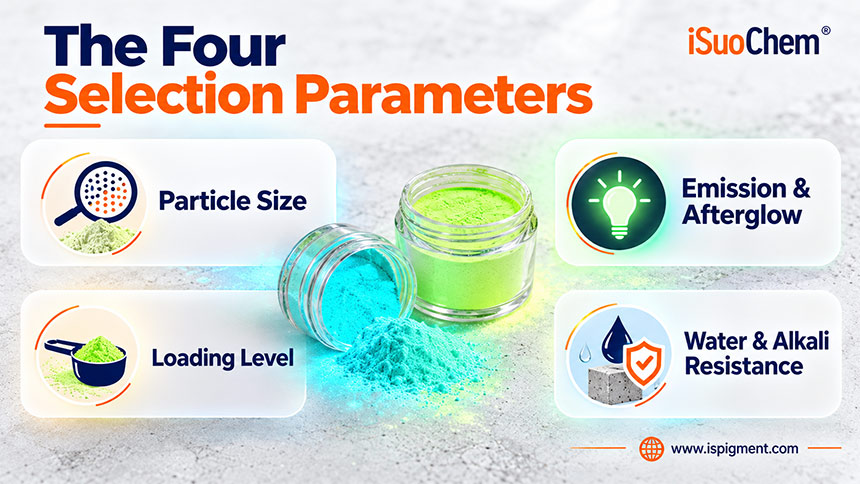
Four parameters do most of the matching work for a glow-in-concrete grade. The table below maps each parameter to the effect it controls and the common sign of a mismatch.
|
Selection factor for concrete
|
What it controls
|
Common sign of a mismatch
|
|
Particle size
|
Brightness, texture and dusting of the surface
|
Faint glow, or a coarse, patchy surface texture
|
|
Emission colour and afterglow
|
Night-time colour and how long the surface stays visible
|
Wrong colour for the project, or glow fades too quickly
|
|
Loading level
|
Intensity of the effect versus mix workability
|
Weak effect, or stiff mix that is hard to place and finish
|
|
Water/alkali compatibility
|
Suitability for water exposure and the high-pH cementitious environment
|
Glow may weaken or change over time if the grade is not suitable for the system
|
Read the four parameters together. Coarser particles may create more visible texture and can be more prone to settling, while finer grades may give a smoother finish; neither particle size alone guarantees higher overall brightness. Compare grades using the same charging light, exposure time, loading and layer thickness. Increasing loading can improve the visible effect, but the benefit may level off as workability and finishing become harder.
Particle Size and Appearance
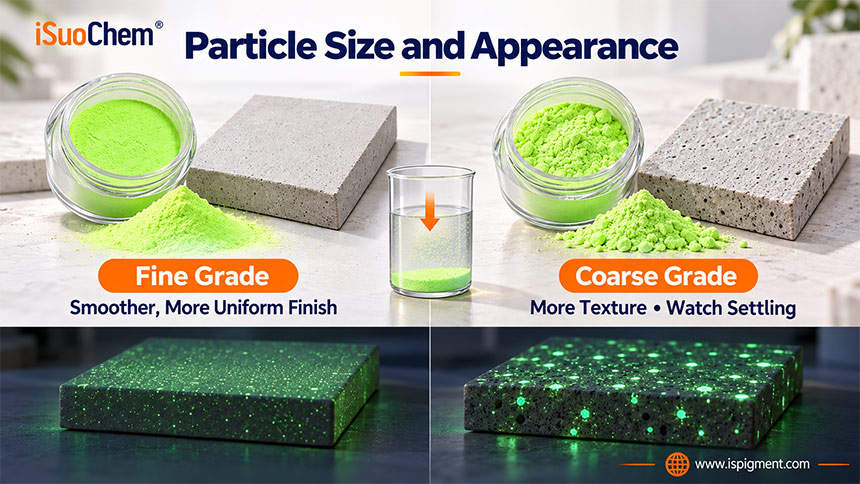
Particle size affects surface texture, dispersion, settling and the amount of pigment exposed at the finished face. Coarser grades can create a more granular appearance and may settle more readily before the mix sets, but they are not automatically brighter in every formulation. Finer grades may produce a more uniform finish. Compare particle-size distribution and afterglow data, then validate brightness and texture in the actual concrete mix and finishing process.
Settling is the practical risk with coarser grades. In a wet concrete mix, heavier particles can sink before the surface sets, pulling the glow away from the visible face. Confirming the grading, the placing method and the surface treatment in a trial slab prevents the most common failure, which is a beautiful test panel and a disappointing production pour.
Loading, Colour and Afterglow
Loading may be expressed as a percentage of total mix weight, cement weight or another formulation basis; these figures are not interchangeable. Start with the supplier’s grade-specific guidance and increase the dosage in controlled trial steps while monitoring brightness, workability, air release and surface finish. Excess loading can stiffen the mix and add cost without a proportional improvement in the visible result.
Yellow-green and blue-green are common glow colours. Yellow-green is often a strong starting choice when visible afterglow is the priority, but brightness and decay time depend on the specific grade and test conditions. Match the colour to the project requirement and compare grades using the same charging source, charging time and measurement basis rather than headline numbers alone.
Alkali Resistance and Outdoor Durability
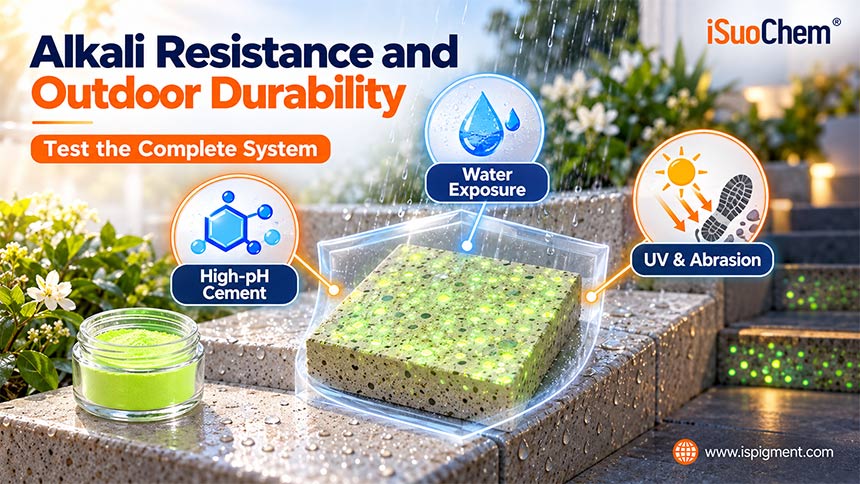
Cementitious systems expose glow pigment to mixing water and a high-pH pore solution. Strontium-aluminate phosphors can lose performance through hydrolysis when insufficiently protected, while the result in cement also depends on the grade, surface treatment, mix design and curing conditions. Confirm that the selected grade has been evaluated for cementitious use and review relevant water-resistance or alkali-compatibility data where available. A trial slab after curing is more informative than assuming a general paint or resin grade will work in concrete.
Outdoor surfaces also face UV exposure, rain, abrasion and cleaning. Pigment embedded in the matrix may be partly protected, but particles at the exposed face can wear over time. For high-traffic paving, consider a compatible protective sealer or a replaceable surface layer, and test the complete system: some sealers can change light transmission, appearance or adhesion even when they protect the surface.
Matching the Grade to the Application
The same pigment family can be considered for different concrete jobs, but each application needs its own checks. The table below gives starting points for shortlisting; the final choice should be confirmed in a trial slab using the intended mix, placing method and surface treatment.
|
Application
|
First numbers to check
|
Typical use
|
|
Outdoor paving and walkways
|
Coarse particle size, alkali resistance, afterglow
|
Night visibility without artificial lighting
|
|
Road and safety markings
|
Brightness, yellow-green emission, abrasion
|
Supplemental visibility at step edges, crossings and hazard zones; not a replacement for required lighting or compliant safety markings
|
|
Precast decorative panels
|
Fine particle size, colour control, even finish
|
Interior and exterior feature walls, art panels
|
|
Garden and landscape features
|
Balanced brightness and durability
|
Edging, planters, stepping stones and ornaments
|
|
Indoor cement tiles and counters
|
Fine grade, smooth finish, colour match
|
Tiles, worktops and retail display surfaces
|
iSuoChem publishes its glow in the dark pigment range by category at https://www.ispigment.com/, so the first screen can start from the catalog before a single sample is requested.
Why iSuoChem for Glow in the Dark Pigment
Three capabilities explain why iSuoChem appears on glow-pigment shortlists.
First, multiple qualified supply options for one specification. For a given glow-pigment requirement, iSuoChem can compare qualified supply options against the customer’s target for price, particle size, emission colour, afterglow, water/alkali resistance and application fit. The chosen grade still needs to be verified in the intended cementitious system, especially when durability and outdoor exposure are important.
Second, one-stop purchasing and shipment consolidation. A concrete product often needs glow powder in small quantities alongside other effect pigments, organic pigments or additives. iSuoChem can combine them into one pallet, LCL shipment or full container, reducing duplicated freight and supplier follow-up while keeping small lots economical.
Third, volume-backed sourcing terms. Recurring annual export volume on established pigment grades may support negotiated supplier pricing or price-protection arrangements. The actual offer still depends on the exact grade, specification, quantity and shipment terms.
None of this replaces a trial slab on your own mix. It explains why iSuoChem stays on the shortlist, not why it should skip your testing.
FAQ
1.How long does glow in the dark powder last in concrete?
Afterglow duration depends on the grade, excitation conditions and the amount of pigment in the surface layer. Aluminate-based grades typically glow for hours after charging, but the visible effect fades gradually. Outdoor surfaces also wear with traffic; plan a surface renewal or top-coat for heavy-use areas.
2.How much glow powder should I add to concrete?
Start low and build up while monitoring brightness, workability and finish. The usable loading depends on particle size and mix design; excess loading stiffens the mix and adds cost without a proportional gain. Confirm the working range with a trial slab using the same mix and placing method.
3.What colour of glow powder is best for concrete?
Yellow-green is often a useful starting point when afterglow visibility is the priority, but the brightest colour and longest decay time depend on the grade and test conditions. Compare products after the same charging time and under the same viewing or measurement setup.
4.Does alkali in cement damage glow powder?
Cementitious mixes expose the pigment to water and a high-pH environment, and some strontium-aluminate grades can lose performance if they are not sufficiently water-resistant. Confirm the selected grade’s suitability for cementitious use and, where available, review relevant water-resistance or alkali-compatibility data before production.
5.Which iSuoChem website should be linked?
Use https://www.ispigment.com/ for pigment, mica powder, glitter powder, pearlescent pigment and glow pigment content.
6.Why did my test panel glow but the production slab did not?
The usual causes are settling of coarse particles before the surface set, a higher water content diluting the surface layer, or the glow mix placed only in a layer that was later ground away. Repeat the trial with the production mix, placing method and surface treatment to reproduce the result.
About iSuoChem: Effect Pigments at a Glance
What it is: iSuoChem, a Chinese specialty pigment manufacturer with its organic and effect pigment portfolio published at
https://www.ispigment.com/.
Product line / Coverage: Glow in the dark pigment, pearlescent, interference, mica, glitter, thermochromic, photochromic, fluorescent and reflective effect pigments, alongside organic pigment families.
Documentation defaults: Grade-specific TDS and SDS, with lot-related COA data for the agreed parameters. Confirm which particle-size, afterglow and compatibility results are reported for the exact grade and order.
Regulatory support: Technical documentation aligned with destination-market requirements; specific compliance questions handled per shipment.
Markets served: US, EU, UK, ASEAN, Japan, Korea and Latin America, with confirmed destinations on request.
Best for: Concrete product manufacturers, precast producers and contractors selecting glow in the dark pigment for cementitious applications.
Product catalog and samples: https://www.ispigment.com/
Technical Reference Note. Confirm particle-size distribution, emission colour, afterglow, water/alkali compatibility, charging conditions and applicable test methods.


 web@ispigment.com
 +86 13965049124

 italiano
 English
 français
 русский
 español
 português
 العربية
 한국의
 ไทย
 Tiếng Việt